
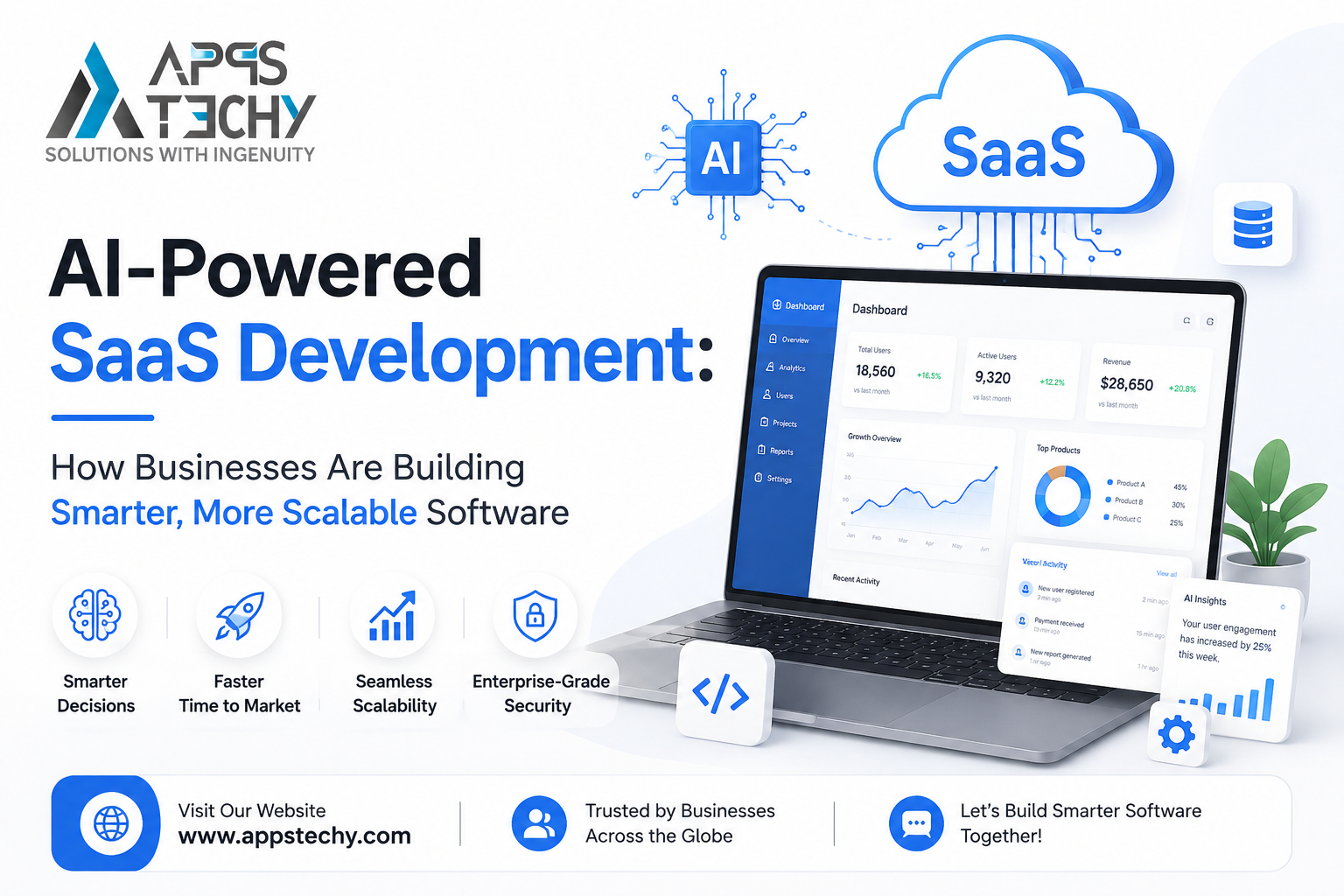
Software-as-a-Service has evolved far beyond simple cloud-based applications. In 2026, businesses are increasingly building SaaS platforms that can analyze information, automate repetitive work, understand user requests, and deliver more personalized experiences. This shift has made AI-Powered SaaS Development a major opportunity for startups and established businesses looking to create smarter, more scalable software products.
But successful AI SaaS development is not about adding a chatbot to an existing application. The real value comes from integrating AI where it solves a genuine business problem.
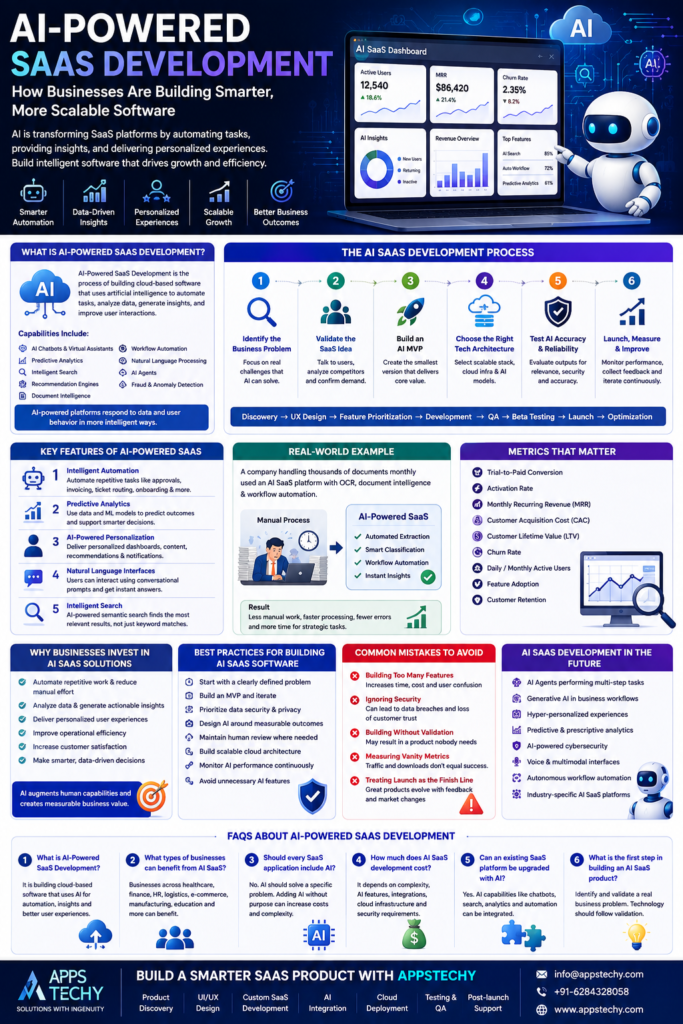
What Is AI-Powered SaaS Development?
AI-Powered SaaS Development is the process of building cloud-based software that uses artificial intelligence to automate tasks, analyze data, generate insights, or improve user interactions.
Depending on the product, AI capabilities may include:
- AI chatbots and virtual assistants
- Predictive analytics
- Intelligent search
- Recommendation engines
- Document intelligence
- Workflow automation
- Natural language processing
- AI agents
- Fraud and anomaly detection
Unlike traditional SaaS applications, AI-powered platforms can respond to data and user behavior in more intelligent ways.
Why Businesses Are Investing in AI SaaS Solutions
Traditional software often requires users to search, analyze, and perform tasks manually. AI changes this model by helping software understand context and assist with decision-making.
For example, instead of manually reviewing hundreds of customer support tickets, an AI SaaS platform can classify requests, identify urgency, summarize conversations, and route tickets to the appropriate team.
This can lead to faster operations, better customer experiences, and more efficient use of employee time.
As AI researcher Andrew Ng has emphasized, AI delivers practical value when it helps automate tasks and augment human capabilities. For SaaS businesses, the opportunity lies in identifying these high-value use cases rather than adding AI simply because it is trending.
Key Features of an AI-Powered SaaS Application
1. Intelligent Automation
AI can automate workflows that previously required manual decisions. This may include invoice processing, lead qualification, employee onboarding, ticket routing, or data entry.
2. Predictive Analytics
Predictive models analyze historical data to identify patterns and forecast potential outcomes. SaaS businesses can use this capability for demand forecasting, churn prediction, sales forecasting, and resource planning.
3. AI-Powered Personalization
Modern users expect software to adapt to their needs. AI can personalize dashboards, recommendations, notifications, and user experiences based on behavior and preferences.
4. Natural Language Interfaces
Instead of navigating multiple menus, users can interact with SaaS platforms using conversational prompts.
For example: “Show me customers who are at risk of churn this month.”
The software can interpret the request and generate the required insight.
5. Intelligent Search
AI-powered semantic search helps users find relevant information even when they do not use the exact keywords stored in the system.
This is particularly useful for knowledge platforms, enterprise software, document management systems, and customer support applications.
A Practical AI SaaS Development Process
Building an AI SaaS product requires more than selecting a large language model or machine learning API. A structured development process is essential.
Step 1: Identify the Business Problem
Start with the problem, not the AI technology. Determine which process is slow, expensive, repetitive, or difficult for users.
Step 2: Validate the SaaS Idea
Interview potential customers and analyze whether they would actually use or pay for the solution.
Step 3: Build an AI MVP
Develop the smallest version capable of demonstrating the product’s core value.
For instance, an AI recruitment platform might initially focus only on resume analysis and candidate matching rather than building a complete HR ecosystem.
Step 4: Choose the Right Technology Architecture
A typical AI SaaS architecture may include a modern frontend, scalable backend, cloud infrastructure, databases, APIs, and AI models. The architecture should support future growth without unnecessarily increasing initial development complexity.
Step 5: Test AI Accuracy and Reliability
AI outputs should be evaluated for relevance, consistency, security, and accuracy. Human oversight may be necessary for high-impact decisions.
Step 6: Launch, Measure, and Improve
After launch, monitor feature adoption, user retention, AI usage, response quality, and business outcomes. These insights should guide future development.
Real-World Example: From Manual Workflows to Intelligent SaaS
Consider a growing B2B company managing thousands of customer documents every month. Employees spend hours manually reviewing files, extracting information, and updating internal systems.
An AI-powered SaaS platform could combine OCR, document intelligence, workflow automation, and AI search. Documents can be processed automatically, important information extracted, and exceptions sent to employees for review.
The result is not simply “AI inside software.” It is a redesigned workflow where people spend less time on repetitive processing and more time handling exceptions and strategic work.
This is where Intelligent SaaS Development can create measurable business value.
Data-Driven Success: What Should Businesses Measure?
Building an AI feature is not the final goal. Businesses should measure whether it improves outcomes.
Important SaaS and AI performance metrics include:
- User activation rate
- Feature adoption
- Customer retention
- Churn rate
- Monthly recurring revenue
- Cost per automated task
- Time saved per workflow
- AI response accuracy
- Customer satisfaction
These metrics help determine whether AI is creating genuine value or simply increasing product complexity.
Future Trends in AI-Powered SaaS Development
The next generation of SaaS platforms will become increasingly intelligent. Key trends include:
- AI agents capable of completing multi-step tasks
- Generative AI integrated into business workflows
- Hyper-personalized user experiences
- Predictive and prescriptive analytics
- AI-powered cybersecurity
- Voice and multimodal interfaces
- Autonomous workflow automation
- Industry-specific AI SaaS platforms
The strongest SaaS products will likely combine automation with human oversight, particularly in industries where accuracy, privacy, and compliance are critical.
Best Practices for Building AI SaaS Software
Businesses should keep several principles in mind:
- Start with a clearly defined customer problem.
- Build an MVP before investing in complex functionality.
- Prioritize data security and privacy.
- Design AI features around measurable outcomes.
- Maintain human review where necessary.
- Build scalable cloud architecture.
- Monitor AI performance continuously.
- Avoid unnecessary AI features.
The best AI SaaS products often feel simple to users, even when complex technology operates behind the scenes.
Frequently Asked Questions
1. What is AI-Powered SaaS Development?
AI-Powered SaaS Development involves creating cloud-based software that uses artificial intelligence for automation, analytics, personalization, decision support, and improved user experiences.
2. What types of businesses can benefit from AI SaaS?
AI SaaS solutions can support businesses across healthcare, finance, HR, logistics, e-commerce, manufacturing, education, and professional services.
3. Should every SaaS application include AI?
No. AI should be implemented when it solves a specific customer or business problem. Adding AI without a clear purpose can increase costs and complexity.
4. How much does AI SaaS development cost?
Costs depend on product complexity, AI functionality, integrations, cloud infrastructure, security requirements, and the scale of the application.
5. Can an existing SaaS platform be upgraded with AI?
Yes. Existing SaaS applications can integrate capabilities such as AI chatbots, intelligent search, predictive analytics, workflow automation, and document processing.
6. What is the first step in building an AI SaaS product?
The first step is identifying and validating a real business problem. Technology selection should follow problem validation—not the other way around.
Build a Smarter SaaS Product with AppsTechy
AI can transform a SaaS application from a simple digital tool into an intelligent platform that automates workflows, delivers insights, and creates more personalized user experiences. At AppsTechy Private Limited, we provide AI-Powered SaaS Development, Custom SaaS Development, MVP Development, AI Integration, Workflow Automation, and scalable cloud-based software solutions tailored to business requirements. Whether you are launching a new AI SaaS startup or adding intelligent capabilities to an existing platform, our team can help you move from idea to a scalable product. Contact AppsTechy to explore how our AI-powered application development services can help build software that is smarter, more efficient, and ready to scale.