



What makes a business website successful in Singapore?
Is a professional design enough, or does a high-performing website need much more?
For businesses competing in Singapore’s digital market, a website needs to do several jobs at once. It should communicate the brand clearly, work smoothly on mobile devices, load quickly, generate enquiries, support search visibility, protect customer information, and provide an easy path from visitor to customer.
Singapore’s Digital Service Standards emphasize responsive design, intuitive navigation, clear language, accessible experiences, contact channels, performance, and reliability as important components of quality digital services.
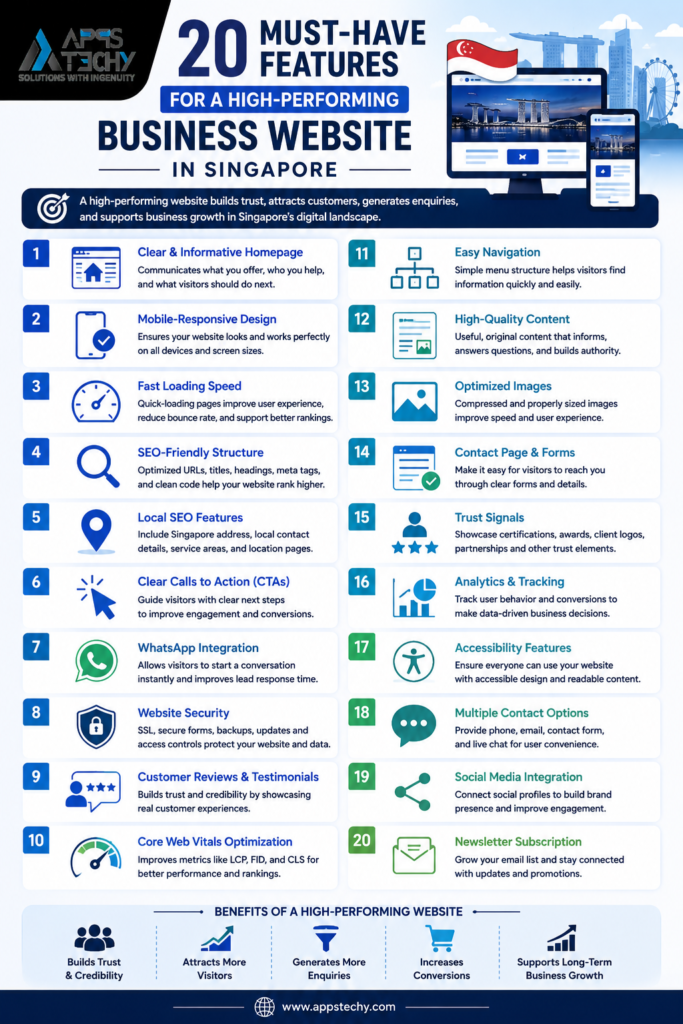
If you’re planning a new website or upgrading an existing one, here are 20 must-have website features worth considering.
1. What Should a Business Website in Singapore Have?
A professional business website should make it easy for visitors to understand what you offer and what they should do next.
At a minimum, consider including:
- Clear homepage
- About Us page
- Services or product pages
- Contact page
- Strong calls to action
- Mobile-responsive design
- Search-friendly page structure
- Customer reviews or testimonials
- Privacy information
- Fast-loading pages
The exact requirements depend on your industry, but the basic objective remains the same: make information easy to find and action easy to take.
2. Why Is Mobile-Responsive Design Important for Singapore Websites?
How does your website look when someone opens it on an iPhone or Android device?
A responsive website automatically adapts its layout to different screen sizes. Navigation, buttons, images, forms, typography, and content should remain usable on smartphones, tablets, laptops, and desktops.
Mobile responsiveness should be treated as a fundamental part of website development rather than an optional feature. Singapore’s digital service guidance specifically recommends responsive web design across different devices and screen sizes.
Businesses planning a responsive website can explore AppsTechy’s Website Development Services Singapore.
3. How Fast Should a Business Website Load?
Would you stay on a website that takes several seconds to display its main content?
Website speed affects both user experience and the overall quality of a digital experience. A high-performing website should minimize unnecessary scripts, optimize images, use efficient code, and monitor Core Web Vitals.
Performance should be considered during development—not only after the website goes live.
4. Does a Singapore Business Website Need SEO-Friendly Structure?
Yes, if organic search is part of your customer acquisition strategy.
A search-friendly website should have:
- Logical URL structures
- Descriptive page titles
- Useful meta descriptions
- Proper heading hierarchy
- Internal links
- Crawlable navigation
- Structured data where appropriate
- Optimized images
- Helpful, original content
SEO should be considered during website architecture and development instead of being added as an afterthought.
5. Should a Singapore Website Include Local SEO Features?
If you serve customers in Singapore, local relevance can be important.
Your website can clearly communicate:
- Singapore service areas
- Business address
- Local phone number
- Business information
- Relevant Singapore-focused service pages
- Customer reviews
- Location information
For businesses serving specific districts or locations, dedicated location pages can also help visitors understand where services are available.
6. Why Does a Website Need Clear Calls to Action?
Imagine a visitor likes your services but cannot figure out how to contact you.
That’s a missed opportunity.
Use clear CTAs such as:
Get a Quote
Book a Consultation
Request a Demo
Call Us
Contact Our Team
Each page should have a logical next step based on the visitor’s intent.
7. Should a Singapore Business Website Have WhatsApp Integration?
For businesses that communicate with customers through messaging, direct chat can reduce friction.
A WhatsApp button can allow visitors to move from browsing to conversation quickly.
However, it should complement—not replace—important contact information such as email, phone, and contact forms.
8. How Important Is Website Security for Singapore Businesses?
Security is essential when a website handles customer information, login credentials, enquiries, payments, or other sensitive data.
Important measures can include:
- HTTPS/SSL
- Secure forms
- Strong authentication
- Regular backups
- Software updates
- Secure APIs
- Access controls
- Monitoring
A secure website also helps establish customer confidence.
9. What Is PDPA Compliance and Why Does It Matter for a Website?
Does your website collect names, email addresses, phone numbers, enquiry details, or other personal information?
If so, Singapore’s Personal Data Protection Act (PDPA) may be relevant to how your organization collects, uses, and manages personal data. Singapore’s regulations also address how business contact information can be made available through an organization’s official website.
Your website should therefore be designed with appropriate privacy and data-handling practices in mind. Depending on the situation, this can include a privacy policy, appropriate consent mechanisms, secure data transmission, and a clear contact channel for data protection matters.
For legal compliance, businesses should obtain advice specific to their circumstances.
10. Why Should a Website Have a Simple Contact Form?
A complicated form can discourage enquiries.
Instead, ask for the information necessary to start the conversation.
For example:
- Name
- Business email
- Phone number
- Service required
- Project details
Make required fields obvious and provide helpful error messages when something goes wrong.
11. Should a Business Website Include Customer Reviews?
How can a new visitor know whether your company is trustworthy?
Reviews and testimonials provide social proof.
Depending on your business, you can showcase:
- Customer testimonials
- Verified reviews
- Client logos
- Ratings
- Project outcomes
- Industry certifications
Place relevant proof close to decision-making points rather than hiding everything on a separate testimonials page.
12. Why Are Case Studies Important for Business Websites?
A service description tells people what you do.
A case study can demonstrate how you solved a real problem.
A useful case study can explain:
Challenge → Solution → Technology → Implementation → Outcome
For a technology company, this can be particularly useful because potential clients often want evidence of how the team approaches complex projects.
AppsTechy’s NexoPD case study and HRMS Connect case study are examples of using project stories to explain solutions and outcomes.
13. Does a Singapore Business Website Need an Easy-to-Use CMS?
Who will update your website after launch?
A content management system can allow internal teams to update:
- Blog posts
- Service pages
- Images
- FAQs
- Case studies
- Landing pages
The right CMS depends on the project’s requirements, technical complexity, security needs, and long-term maintenance plan.
14. Why Should a Website Include Analytics and Conversion Tracking?
How will you know whether your website is actually generating business?
Analytics can help you understand:
- Where visitors come from
- Which pages they view
- Which devices they use
- Where visitors leave
- Which CTAs receive clicks
- How many enquiries are generated
Conversion tracking is especially useful because traffic alone doesn’t tell you whether the website is producing meaningful business outcomes.
15. Should an E-Commerce Website Support Singapore Payment Methods?
If you’re selling products or services online, the payment experience needs to be simple and trustworthy.
Depending on your target customers and payment provider, an e-commerce website may integrate options such as cards, digital wallets, or Singapore-focused payment methods.
The exact payment integrations should be selected based on your customers, platform, transaction requirements, and payment provider.
16. Why Is Website Accessibility Important?
Can every visitor comfortably navigate your website?
Accessibility considerations include:
- Readable typography
- Sufficient contrast
- Keyboard navigation
- Descriptive labels
- Alternative text
- Clear focus states
- Logical heading structure
Accessibility improves usability and helps create a more inclusive digital experience.
17. Why Does Website Navigation Matter So Much?
If visitors cannot find your services, products, contact information, or important resources, even excellent content becomes less useful.
Keep navigation:
- Simple
- Predictable
- Consistent
- Descriptive
- Easy to use on mobile
A logical information architecture also makes it easier for search engines to understand the relationships between your pages.
18. Should a Business Website Integrate With CRM and Other Business Tools?
What happens after someone submits your website form?
Without integration, your team may need to manually copy enquiries into another system.
CRM, email marketing, appointment booking, payment, ERP, analytics, and other API integrations can automate parts of this process.
For growing businesses, integrations can turn a website from a simple online brochure into a more connected business platform.
19. How Can AI Features Improve a Business Website?
AI can be useful when it solves a genuine customer or business problem.
Potential applications include:
- AI chat assistants
- Intelligent website search
- Product recommendations
- Automated FAQ responses
- Lead qualification
- Personalized content
- Document processing
The important question isn’t “Can we add AI?”
It is:
“Where can AI make the customer’s experience faster or more useful?”
20. Why Does a Business Website Need Ongoing Maintenance?
Launching a website is not the end of the project.
Websites need ongoing attention for:
- Security updates
- Software updates
- Broken links
- Performance monitoring
- Backups
- Content updates
- SEO improvements
- Conversion optimization
- Technical fixes
Regular maintenance helps keep a website secure, functional, and aligned with changing business requirements.
What Makes a Website High-Performing in Singapore?
A high-performing business website isn’t defined by one feature.
It is the combination of:
Performance + Mobile UX + SEO + Security + Accessibility + Clear Content + Conversion Paths + Analytics + Continuous Improvement
For Singapore businesses, local relevance and appropriate privacy/data practices should also be considered during planning.
AppsTechy’s Web Development Services in Singapore focus on building websites around business requirements, user experience, performance, and scalable development.
How Can You Choose the Right Website Development Approach?
Before starting development, ask:
- Who are your primary customers?
- What do you want visitors to do?
- Do you need e-commerce functionality?
- Will your team need a CMS?
- Do you need CRM or API integrations?
- What information will you collect?
- What are your SEO goals?
- Does the website need multilingual content?
- What are your performance expectations?
- How will success be measured?
Answering these questions first can prevent expensive redesigns later.
FAQs About Business Website Development in Singapore
A professional website should generally include clear business information, services or products, contact options, responsive design, SEO-friendly architecture, security, analytics, and relevant trust signals.
The cost depends on factors such as the number of pages, design complexity, CMS, e-commerce requirements, integrations, custom functionality, content, and ongoing support. A simple corporate website and a custom web application can have very different development requirements.
Yes. A responsive experience helps ensure visitors can use the website effectively across smartphones, tablets, and desktop devices. Singapore’s Digital Service Standards specifically recommend responsive web design across different screen sizes.
There isn’t one feature that works for every business. The website should make it easy for the intended audience to understand the offering, find information, and complete the desired action.
Only when it provides a clear benefit. AI chat, search, recommendations, automation, and personalization can be useful, but they should support a defined customer or business need rather than being added simply because AI is trending.
Building SEO into the architecture from the beginning can help create cleaner URLs, logical page structures, proper heading hierarchies, internal linking, crawlability, and technically sound pages.
Final Thoughts
A high-performing business website in Singapore needs to be more than an attractive digital brochure. It should provide a fast and responsive experience, make information easy to find, create clear conversion paths, protect customer information, support search visibility, and connect with the tools your business already uses.
Whether you’re launching a new company website, redesigning an existing platform, or building a custom web application, choosing the right features at the planning stage can make the website easier to scale and maintain.
If you’re planning a new website for your Singapore business, explore AppsTechy’s Web Development Services in Singapore or visit the AppsTechy website to explore its broader technology services. Have a website project in mind? Contact AppsTechy today to discuss your requirements and find the right website development approach for your business.