


Does your website work properly on every device?
If visitors have to zoom, scroll sideways, or struggle to click buttons on their phones, your website may be losing potential customers before they even contact you.
A responsive website automatically adapts its layout, content, images, navigation, and interactive elements to different screen sizes. But responsive design is about more than making a website look good on smartphones. It can influence usability, search visibility, engagement, conversions, and the overall perception of your business.
So, how can responsive website design help a business grow?
Here are 10 practical ways.
1. How Can Responsive Web Design Improve the Customer Experience?
What happens when someone visits your website from a smartphone and the page looks exactly as it does on a desktop?
They may have to pinch and zoom, scroll unnecessarily, or struggle to find the right button.
Responsive design solves this by adapting the interface to the visitor’s screen.
A responsive website can provide:
- Easier navigation
- Readable text
- Properly sized buttons
- Flexible images
- Mobile-friendly forms
- Consistent layouts
The easier your website is to use, the less friction visitors experience when looking for information or contacting your business.
2. Why Is Mobile-Friendly Website Design Important for Business Growth?
A large percentage of website visitors may access your business through smartphones.
That means your mobile website isn’t a secondary version of your website. For many customers, it may be their first interaction with your brand.
A responsive design ensures that important information remains accessible across smartphones, tablets, laptops, and desktops.
For businesses planning a new website, AppsTechy’s Responsive Website Development Services can help create interfaces designed for different screen sizes and user journeys.
3. Can Responsive Design Increase Website Conversions?
Can a mobile visitor easily find your “Get a Quote” button?
If the answer is no, your website may be creating unnecessary conversion friction.
Responsive design can make important conversion elements easier to access, including:
- Contact forms
- Call buttons
- Quote requests
- Product pages
- Checkout buttons
- Appointment forms
The goal isn’t simply to make buttons smaller for mobile. It is to rethink how users interact with the page on different devices.
4. How Does Responsive Design Affect Website SEO?
Search engines need to understand and crawl your website efficiently, while users need to access the content easily.
A responsive approach allows businesses to maintain one website experience across devices rather than creating completely separate desktop and mobile versions.
Responsive design should also work alongside:
- Clean page architecture
- Fast loading times
- Proper heading structures
- Descriptive URLs
- Internal linking
- Optimized images
- Useful content
For businesses investing in SEO Services, responsive design should be treated as part of the broader technical and user-experience strategy.
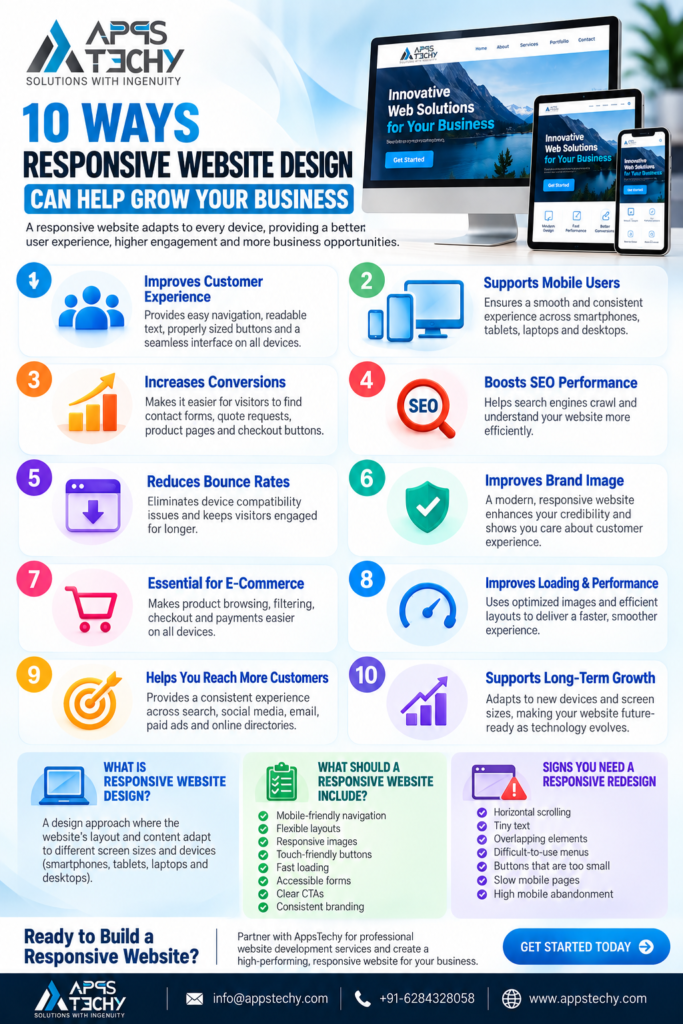
5. Can Responsive Web Design Reduce Website Bounce Rates?
Why do visitors leave a website quickly?
There can be many reasons—poor content, slow loading, confusing navigation, or an interface that doesn’t work properly on their device.
Responsive design can remove one major source of friction: device compatibility.
If visitors can comfortably read your content and navigate the website without fighting the interface, they have a better opportunity to continue exploring your pages.
However, responsive design alone doesn’t guarantee lower bounce rates. Content quality, page speed, intent matching, and overall UX also matter.
6. How Can Responsive Design Improve Your Brand Image?
Imagine two businesses offering similar services.
One has a modern website that works smoothly on mobile devices. The other has tiny text, broken layouts, and buttons that are difficult to use.
Which business appears more professional?
Your website is often one of the first places potential customers interact with your brand. A consistent and responsive experience can reinforce the perception that your business pays attention to quality and customer experience.
7. Why Is Responsive Design Important for E-Commerce Websites?
For online stores, responsive design can directly influence how customers browse and purchase products.
A mobile-friendly e-commerce experience should make it easy to:
- Browse products
- Use filters
- View product images
- Read descriptions
- Add products to a cart
- Enter delivery information
- Complete payment
A poor mobile checkout experience can create unnecessary abandonment.
For businesses building or improving an online store, responsive design should therefore be considered from the beginning rather than added after development.
8. Can Responsive Design Improve Website Loading and Performance?
Responsive design and performance are not exactly the same thing, but they should be planned together.
A responsive website can be built with device-appropriate images, efficient layouts, optimized assets, and carefully managed scripts.
Performance optimization should also consider:
- Image compression
- Browser caching
- CSS and JavaScript
- Font loading
- Third-party scripts
- Server response time
- Core Web Vitals
A fast responsive website creates a much stronger experience than a responsive website that takes too long to become usable.
9. How Can Responsive Design Help Businesses Reach More Customers?
Your customers don’t all use the same device.
Some may discover your business through:
- Mobile search
- Social media
- Desktop search
- Online directories
- Referral links
- Paid advertising
A responsive website provides a consistent destination regardless of where the visitor comes from or which device they use.
That makes responsive design particularly important for businesses running multi-channel marketing campaigns.
10. Why Should Businesses Choose Responsive Design for Long-Term Growth?
Technology and customer behavior continue to change.
New smartphones, tablets, screen sizes, browsers, and devices appear regularly. Building a website around one fixed screen size can create problems as the digital environment changes.
Responsive design provides a more flexible foundation.
Instead of rebuilding the entire website whenever a new screen size becomes popular, the interface can adapt using flexible layouts, grids, media queries, scalable components, and responsive assets.
This makes responsive design a practical choice for businesses that want a website capable of evolving with their customers.
What Is Responsive Website Design?
Responsive website design is an approach to web development where the website’s layout and content adapt to different screen sizes and devices.
For example:
Desktop → Tablet → Smartphone
The content remains accessible while the layout, navigation, images, columns, buttons, and other components adjust according to the available screen space.
Responsive design is different from simply creating a smaller version of a desktop website. The user experience itself should be considered for each device context.
What Should a Responsive Business Website Include?
A high-quality responsive website should consider more than screen size.
Important elements include:
- Mobile-friendly navigation
- Flexible layouts
- Responsive images
- Touch-friendly buttons
- Readable typography
- Fast loading
- Accessible forms
- Clear CTAs
- Consistent branding
- Search-friendly architecture
- Cross-browser compatibility
Testing should be performed across multiple screen sizes rather than relying only on one smartphone or desktop.
How Can You Tell If Your Website Needs a Responsive Redesign?
Your website may need a redesign if visitors frequently encounter:
- Horizontal scrolling
- Tiny text
- Overlapping elements
- Difficult-to-use menus
- Buttons that are too small
- Broken layouts
- Slow mobile pages
- Forms that are difficult to complete
- Poor mobile engagement
- High abandonment from mobile visitors
Before redesigning, review analytics and test the most important customer journeys on different devices.
FAQs About Responsive Website Design
Responsive website design allows a website’s layout and content to adapt to different screen sizes, including smartphones, tablets, laptops, and desktop computers.
It can improve usability, accessibility, mobile experience, brand perception, and the ability of visitors to complete important actions such as contacting the business or making a purchase.
Responsive design supports a consistent website experience across devices and can complement a technically sound SEO strategy. However, responsive design by itself does not guarantee higher rankings.
In most cases, yes. Even a small business website should provide a usable experience for visitors accessing it from smartphones and other devices.
The cost depends on the website’s number of pages, design complexity, CMS, custom functionality, integrations, content, e-commerce requirements, and development approach.
Yes. An existing website can often be redesigned or rebuilt using responsive layouts. The best approach depends on the existing codebase, CMS, design, performance, and technical limitations.
Final Thoughts
Responsive website design is no longer simply about making a website “fit on mobile.” It is about creating a consistent, accessible, fast, and conversion-focused experience across the devices your customers actually use.
From improving mobile usability and supporting conversions to strengthening your overall website experience, responsive design can provide a stronger foundation for long-term digital growth.
Responsive design can influence more than visual appearance—it can affect how easily visitors navigate, interact with forms, and complete purchases. For a deeper look at the connection between responsive design, traffic, leads, and sales, see our guide on How Responsive Website Design Is Driving More Traffic, Leads & Sales in 2026.
If you’re planning a new website or redesigning an existing one, explore AppsTechy’s Website Development Services to create a responsive website around your business goals and customer needs. Have a website project in mind? Contact AppsTechy today to discuss your requirements and find the right responsive web design and development approach for your business.