


Artificial intelligence is changing how businesses build and use software. In 2026, an AI-powered application is expected to do more than store data or complete basic transactions. Businesses increasingly want software that can understand information, automate repetitive tasks, predict outcomes, and help employees make faster decisions.
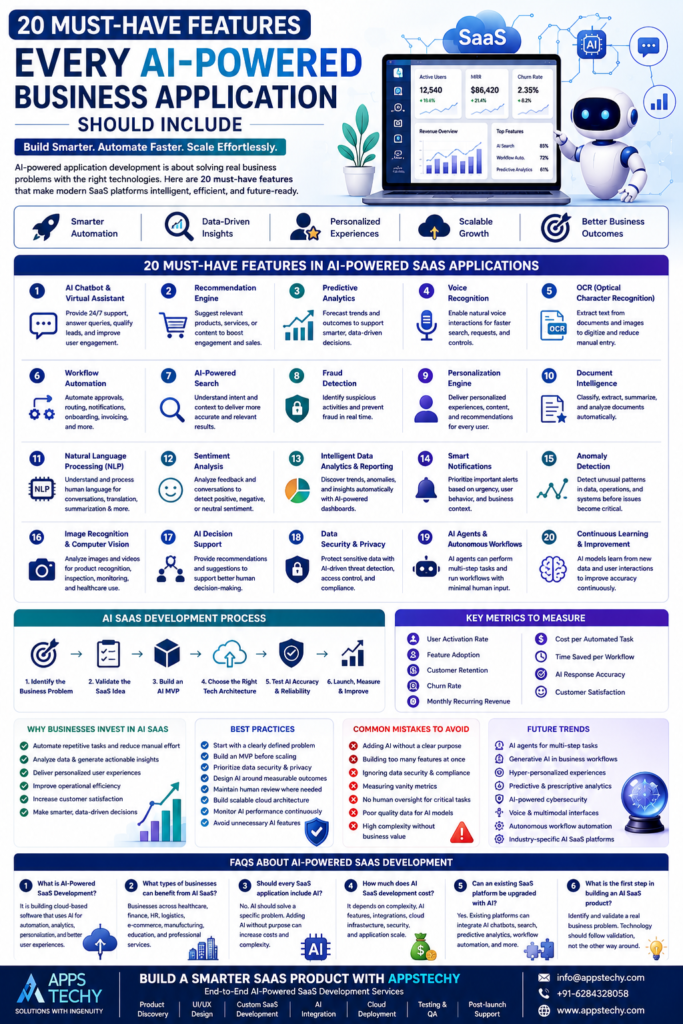
However, successful AI-powered application development is not about adding every available AI feature. The best applications combine the right technologies to solve real business problems. From AI chatbots and predictive analytics to document intelligence and workflow automation, here are 20 features businesses should consider.
1. AI Chatbot and Virtual Assistant
An AI chatbot can answer customer questions, assist employees, qualify leads, and provide support around the clock. Modern chatbots can understand context and interact more naturally than traditional rule-based systems.
2. Recommendation Engine
Recommendation engines analyze user behavior, preferences, and historical activity to suggest relevant products, services, or content. This feature can improve engagement and conversion opportunities.
3. Predictive Analytics
Predictive analytics uses historical and real-time data to forecast future outcomes. Businesses can use it for sales forecasting, customer churn prediction, inventory planning, and demand forecasting.
4. Voice Recognition
Voice-enabled applications allow users to search, create requests, access information, or control workflows through natural speech. This can improve accessibility and speed up common tasks.
5. Optical Character Recognition (OCR)
OCR converts information from scanned documents, invoices, receipts, and images into digital, searchable data. It can significantly reduce manual data entry.
6. Workflow Automation
AI-powered workflow automation helps manage repetitive processes such as approvals, ticket routing, notifications, invoice processing, and employee onboarding.
Instead of employees manually moving information between systems, automated workflows can handle routine actions based on predefined rules and AI-driven decisions.
7. AI-Powered Search
Traditional search depends heavily on exact keywords. AI-powered semantic search can understand user intent and context, helping users find relevant documents, products, or information more efficiently.
8. Fraud Detection
AI can analyze transactions and behavioral patterns to identify unusual or potentially fraudulent activity. This feature is particularly valuable for fintech, banking, insurance, and e-commerce applications.
9. Personalization Engine
A personalization engine adapts content, recommendations, notifications, and user experiences based on individual behavior and preferences.
For example, two users may see completely different dashboards based on their roles and previous activity.
10. Document Intelligence
Document intelligence goes beyond OCR. AI can classify documents, extract important information, summarize lengthy files, and identify specific clauses or data points.
This capability is useful in finance, legal services, healthcare, HR, and enterprise operations.
11. Natural Language Processing
Natural Language Processing, or NLP, enables applications to understand and process human language.
NLP can support features such as text summarization, sentiment analysis, language translation, conversational interfaces, and automated content classification.
12. Sentiment Analysis
Businesses receive valuable feedback through customer reviews, support tickets, surveys, and messages. Sentiment analysis can help identify whether interactions are positive, negative, or neutral.
This allows teams to detect customer issues before they become larger problems.
13. Intelligent Data Analytics and Reporting
Instead of requiring employees to manually analyze spreadsheets, AI can identify patterns, anomalies, and trends automatically.
An intelligent dashboard can answer questions such as:
- Why are sales declining?
- Which customers are likely to churn?
- Which region is growing fastest?
The goal is to move from raw data toward actionable insights.
14. Smart Notifications
Not every notification deserves immediate attention. AI can prioritize alerts based on urgency, user behavior, and business context.
This helps reduce notification fatigue while ensuring important events receive attention.
15. Anomaly Detection
AI-powered anomaly detection continuously monitors data and identifies unusual patterns.
Businesses can use it to detect operational issues, unexpected financial activity, system failures, cybersecurity risks, or unusual customer behavior.
16. Image Recognition and Computer Vision
Computer vision enables applications to analyze images and video.
Possible use cases include product recognition, quality inspection, inventory monitoring, medical image analysis, and manufacturing defect detection.
17. AI Decision Support
AI should not always replace human decision-making. In many business applications, its most valuable role is providing recommendations based on available data.
For example, an inventory management platform might recommend when to reorder a product based on historical sales and predicted demand.
18. Automated Report Generation
AI can automatically create summaries, performance reports, financial insights, and operational updates.
This reduces the time employees spend collecting information and preparing recurring reports.
19. Real-Time Translation
Businesses operating across global markets can use AI-powered translation to support communication between employees, customers, and partners.
Real-time translation can make applications more accessible to multilingual audiences.
20. Continuous Learning and Optimization
An effective AI-powered application should be monitored and improved over time. Models, prompts, workflows, and automation rules need regular evaluation as business requirements and data change.
Continuous optimization helps ensure AI features remain useful, accurate, and aligned with business goals.
Real-World Use Case: Combining Multiple AI Features
Consider a company that processes thousands of customer requests and business documents every month. Employees manually review files, search for information, assign requests, and prepare reports.
An AI-powered business application could combine:
- OCR and document intelligence for data extraction
- AI search for faster information retrieval
- Workflow automation for request routing
- Predictive analytics for forecasting
- Chatbots for employee and customer assistance
Instead of treating these as separate tools, the business can create one connected application where data flows between intelligent features.
The biggest opportunity is not simply automating one task. It is reducing friction across the entire business process.
Data-Driven Analysis: Measuring AI Application Success
Businesses should measure outcomes rather than simply counting the number of AI features in an application.
Useful performance indicators include:
- Reduction in manual processing time
- Improvement in task completion speed
- AI response accuracy
- Customer satisfaction scores
- Workflow completion rates
- Cost savings
- Employee productivity
- User adoption and feature usage
For example, an AI chatbot may appear successful because it handles thousands of conversations. But the more important question is whether it resolves customer issues without requiring human escalation.
This outcome-focused approach helps businesses identify which AI capabilities are delivering genuine value.
Expert Perspective: AI Should Augment, Not Just Automate
AI researcher and entrepreneur Andrew Ng has consistently emphasized the importance of identifying practical tasks where AI can create real value. For business applications, this means focusing on repetitive, data-intensive, or time-consuming processes where intelligent automation can support employees.
The strongest AI applications do not necessarily remove humans from the process. Instead, they help people access information faster, automate routine work, and make more informed decisions.
Best Practices for Building an AI-Powered Business Application
Before adding AI functionality, businesses should consider the following:
- Start with a clearly defined business problem.
- Prioritize features based on measurable value.
- Ensure high-quality and secure data handling.
- Build AI capabilities that integrate with existing workflows.
- Include human oversight for critical decisions.
- Test AI outputs for reliability and accuracy.
- Monitor performance after deployment.
- Design the architecture to support future scalability.
A successful application does not need all 20 features. The right combination depends on the industry, users, available data, and business objectives.
Frequently Asked Questions
1. What is an AI-powered business application?
An AI-powered business application uses technologies such as machine learning, natural language processing, computer vision, or generative AI to automate tasks, analyze data, and improve decision-making.
2. Which AI feature should a business implement first?
The best starting point depends on the biggest business challenge. Customer-focused companies may prioritize AI chatbots and personalization, while operations-heavy businesses may benefit more from workflow automation or document intelligence.
3. Can small businesses use AI-powered applications?
Yes. Cloud platforms, APIs, and AI services have made intelligent software capabilities more accessible to startups and small businesses.
4. How does AI workflow automation work?
AI workflow automation combines automation rules with intelligent capabilities such as document processing, natural language understanding, and predictive analysis to manage business processes with less manual intervention.
5. Are AI-powered applications secure?
They can be secure when built with appropriate security measures, including encryption, access controls, authentication, secure APIs, data governance, and regular monitoring.
6. Should every business application include generative AI?
No. Generative AI should be included when it provides a clear benefit to users or business operations. Technology should support the product’s purpose rather than become an unnecessary feature.
Build Smarter AI Applications with AppsTechy
The most successful AI-powered business applications are built around real problems, measurable outcomes, and scalable technology. At AppsTechy, we help businesses develop intelligent digital products through AI-powered application development, custom software development, workflow automation, SaaS development, AI integration, API development, and scalable cloud solutions.
Whether you want to build a new AI-powered platform or add intelligent features to an existing application, our team can help you identify the right use cases and develop a solution that fits your business goals. Contact AppsTechy to explore our AI-powered application development services and start building smarter, more efficient software.