
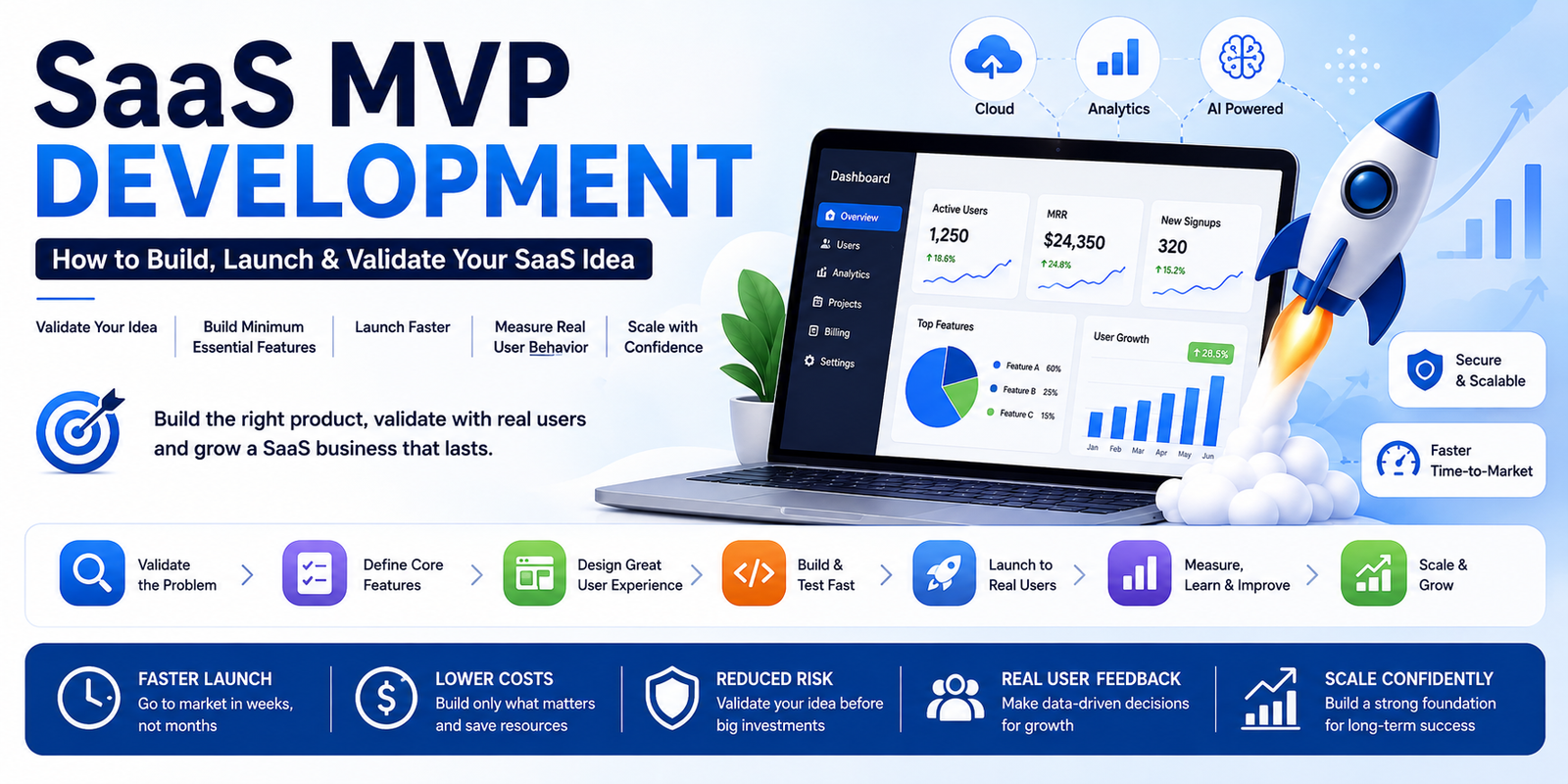
Building a SaaS product is exciting, but developing the entire platform before knowing whether customers will pay for it can be an expensive mistake. SaaS MVP Development offers a smarter approach: build the smallest useful version of your software, launch it to real users, measure their behavior, and use those insights to shape the next version.
In 2026, SaaS startups are also using AI, cloud-native technologies, automation, and analytics to shorten development cycles and test ideas faster. But technology alone does not validate a SaaS business. Customer demand, usability, retention, and willingness to pay do.
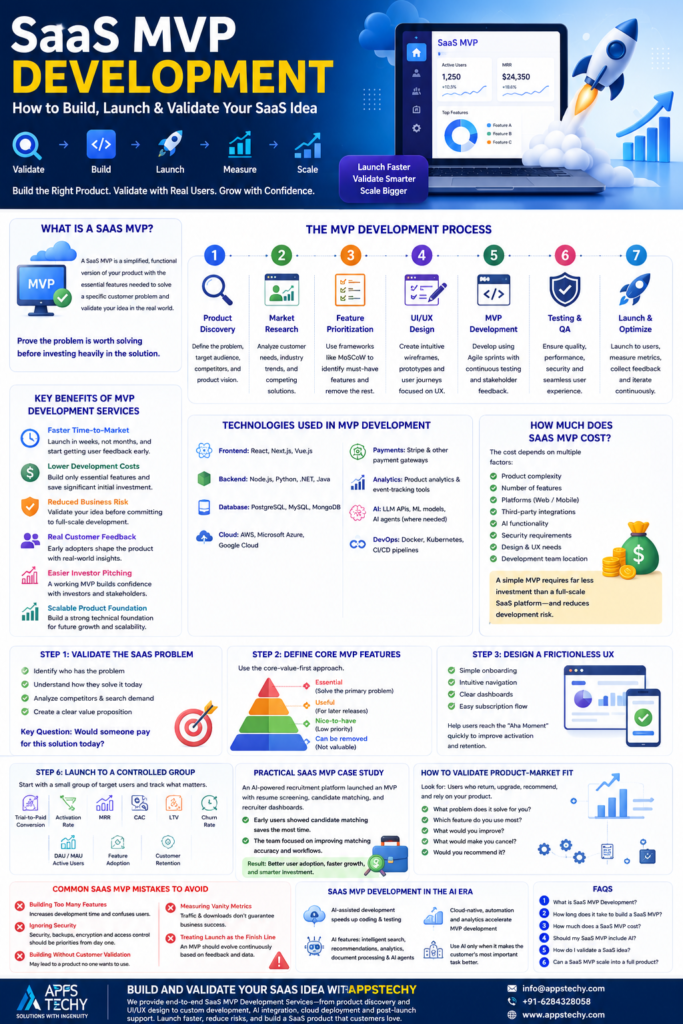
What Is a SaaS MVP?
A SaaS MVP is an early, functional version of a cloud-based software product containing the essential features needed to solve a specific customer problem.
For example, instead of building a complete project-management platform with dozens of integrations, an MVP might focus on three capabilities: creating projects, assigning tasks, and tracking progress.
The objective is simple: prove that the problem is worth solving before investing heavily in the solution.
Step 1: Validate the SaaS Problem Before Development
Before writing code, identify who has the problem, how they currently solve it, and why existing solutions are insufficient.
Talk to potential customers, analyze competitors, review search demand, and create a clear value proposition.
A useful validation question is:
“Would someone pay for this solution today?”
Positive feedback is helpful, but actual sign-ups, trial registrations, pre-orders, or payments provide stronger evidence.
Step 2: Define Your Core SaaS MVP Features
One of the most common SaaS mistakes is trying to build too much.
Use the core-value-first approach. Divide potential features into:
- Essential for solving the primary problem
- Useful but suitable for later releases
- Nice-to-have features
- Features that can be removed entirely
For example, an AI-powered customer-support SaaS might begin with AI ticket classification, automated responses, a knowledge base, and a simple analytics dashboard instead of building an entire enterprise support ecosystem.
Step 3: Design a Frictionless User Experience
A SaaS MVP doesn’t need hundreds of features, but it should be easy to understand.
Create simple onboarding, intuitive navigation, clear dashboards, and straightforward subscription flows. Users should be able to reach the product’s “aha moment” quickly.
This is particularly important for SaaS products because poor onboarding can increase trial abandonment before users experience the product’s value.
Step 4: Choose a Scalable Technology Stack
Your technology choices should support rapid development without creating unnecessary technical debt.
A typical SaaS MVP stack may include:
- Frontend: React, Next.js or Vue.js
- Backend: Node.js, Python, .NET or Java
- Database: PostgreSQL, MySQL or MongoDB
- Cloud: AWS, Microsoft Azure or Google Cloud
- Payments: Stripe or another suitable payment gateway
- Analytics: Product analytics and event-tracking platforms
- AI: LLM APIs, machine learning models or AI agents where appropriate
For many startups, a cloud-native architecture combined with modular APIs provides the flexibility needed for future growth.
Step 5: Build, Test and Launch Quickly
Use Agile development and short development cycles rather than waiting for a “perfect” product.
A practical SaaS MVP development process includes:
Discovery → UX Design → Feature Prioritization → Development → QA → Beta Testing → Launch → Optimization
Before launch, test authentication, payments, data security, performance, mobile responsiveness, error handling, and critical user journeys.
How Much Does SaaS MVP Development Cost?
The cost depends on product complexity, number of platforms, integrations, design requirements, AI capabilities, security requirements, and development resources.
A simple SaaS MVP may require significantly less investment than an enterprise SaaS platform with advanced analytics, complex permissions, third-party integrations, and AI functionality.
Instead of selecting a development partner purely on hourly rates, evaluate time-to-market, technical expertise, scalability, security, and post-launch support.
Step 6: Launch to a Controlled Group
You don’t need thousands of customers on day one.
Start with a small group of target users. A controlled beta makes it easier to observe how people actually use the product and identify friction points.
Track metrics such as:
- Trial-to-paid conversion
- Activation rate
- Monthly recurring revenue (MRR)
- Customer acquisition cost (CAC)
- Customer lifetime value (LTV)
- Churn rate
- Daily/monthly active users
- Feature adoption
- Customer retention
These metrics tell you whether the SaaS product is creating sustainable value—not simply attracting website visitors.
A Practical SaaS MVP Case Study
Imagine a startup developing an AI-powered recruitment platform.
The original product roadmap includes automated resume screening, interview scheduling, candidate scoring, analytics, payroll integrations, employee onboarding, and workforce planning.
Instead of developing everything, the startup launches an MVP focused on resume screening, candidate matching, and recruiter dashboards.
Early users reveal that candidate matching saves the most time. The company then invests its next development cycle in improving matching accuracy and integrating recruitment workflows.
This approach prevents the team from spending months building features that customers may never use.
How to Validate Product-Market Fit
Launching your SaaS MVP is only the beginning.
Look for evidence that users repeatedly return to the product, recommend it, upgrade subscriptions, and consider the solution difficult to replace.
Qualitative feedback matters too. Ask customers:
- What problem does the product solve for you?
- Which feature do you use most?
- What would you improve?
- What would make you cancel?
- Would you recommend it to another business?
Combine these answers with behavioral analytics to make better product decisions.
Common SaaS MVP Mistakes to Avoid
Building Too Many Features
Feature overload increases development time and makes the product harder to use.
Ignoring Security
SaaS applications handle valuable customer data, making authentication, authorization, encryption, backups, and secure development essential from the beginning.
Building Without Customer Validation
A technically impressive product can still fail if it solves a problem customers don’t consider important.
Measuring Vanity Metrics
Website traffic and downloads are useful, but retention, activation, conversion, and revenue provide stronger evidence of SaaS viability.
Treating Launch as the Finish Line
A successful MVP should evolve continuously based on customer behavior and market feedback.
SaaS MVP Development in the AI Era
AI is changing how SaaS products are built and used. AI-assisted development can accelerate coding and testing, while AI features such as intelligent search, recommendation engines, document processing, predictive analytics, and AI agents can create new SaaS business models.
However, adding AI simply because it is trending can increase costs without improving the product.
The better question is:
“Does AI make the customer’s most important task faster, easier, cheaper, or more accurate?”
If the answer is yes, AI may belong in the MVP. If not, it can wait.
FAQs About SaaS MVP Development
SaaS MVP Development is the process of creating and launching a minimum viable version of a cloud-based software product to validate its market demand and business model.
The timeline depends on the number of features, integrations, design complexity, and technology requirements. A focused MVP can often be developed much faster than a full-scale SaaS platform.
There is no fixed price. Development costs depend on functionality, platforms, integrations, AI requirements, security, and development expertise.
Include AI when it directly supports the product’s core value proposition. Avoid adding AI features simply for marketing purposes.
Conduct customer interviews, analyze competitors, create a prototype, collect early sign-ups, run a beta program, and measure real usage and willingness to pay.
Yes. A well-architected MVP can become the foundation for a larger SaaS platform as customer requirements, revenue, and usage increase.
Build and Validate Your SaaS Idea with AppsTechy
A successful SaaS product isn’t created by building everything at once. It starts with a focused problem, a carefully prioritized MVP, real customer feedback, and continuous improvement. AppsTechy provides end-to-end SaaS MVP Development Services, including product discovery, UI/UX design, custom SaaS development, AI integration, API development, cloud deployment, testing, and post-launch support. Whether you’re validating a startup concept or introducing a new SaaS product within an established business, our team can help you turn your idea into a scalable, market-ready solution. Contact AppsTechy to discuss your SaaS MVP and take the first step toward building, launching, and validating your product.