

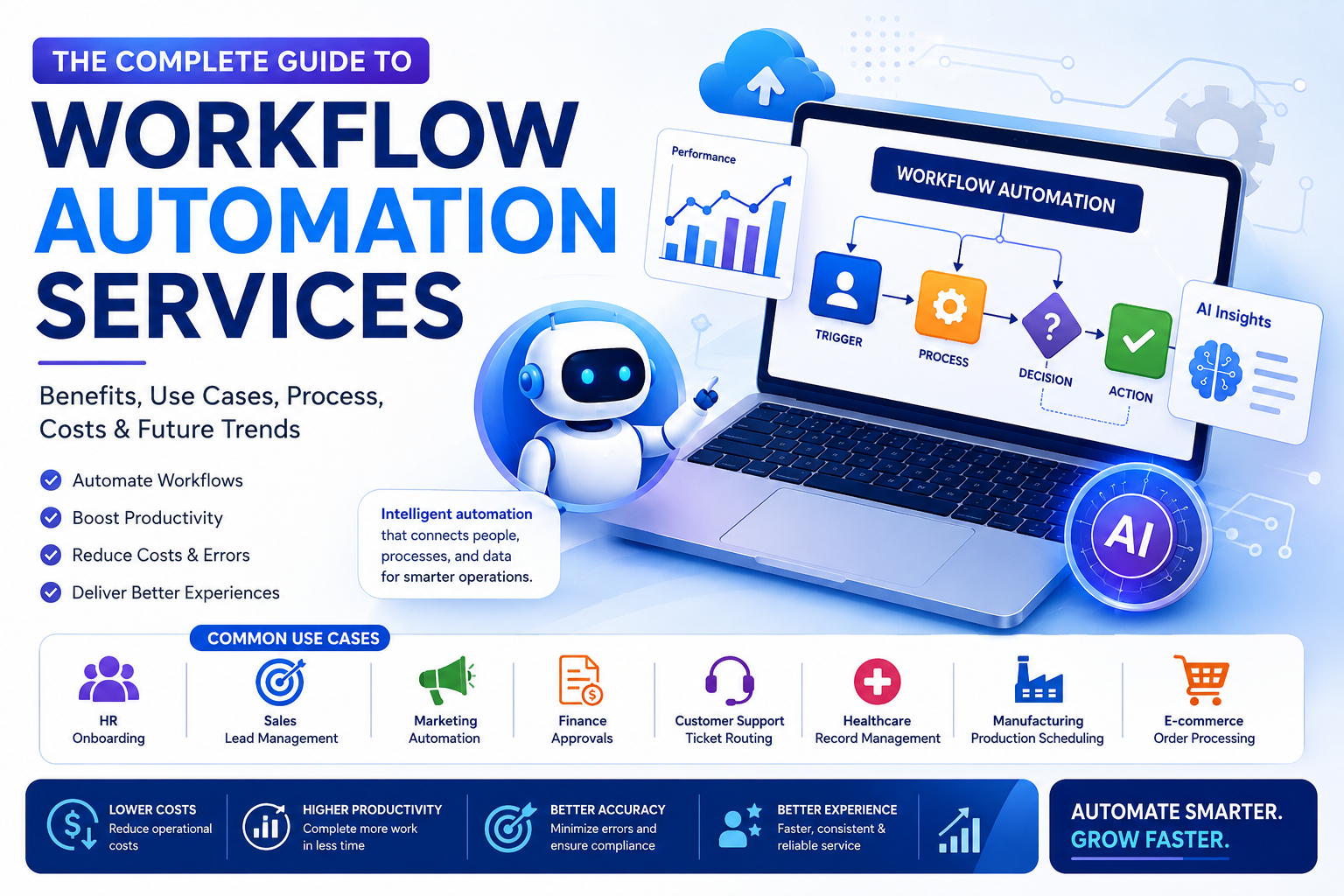
Businesses in 2026 are under constant pressure to do more with less. Customers expect faster responses, employees want streamlined processes, and leaders need real-time visibility into operations. This is where Workflow Automation Services become a game changer. By combining artificial intelligence, cloud technologies, and intelligent process automation, organizations can eliminate repetitive tasks, reduce errors, and improve productivity across departments.
Whether you’re a startup looking to automate approvals or a large enterprise managing thousands of daily transactions, workflow automation has become an essential investment for digital transformation.
What Are Workflow Automation Services?
Workflow Automation Services involve designing, developing, and implementing software that automates repetitive business processes with minimal human intervention. Modern AI Workflow Automation Services go beyond simple rule-based workflows by incorporating machine learning, predictive analytics, document intelligence, and AI-powered decision-making.
Instead of manually approving invoices, assigning support tickets, or updating CRM records, businesses can automate these tasks using intelligent workflows that operate faster, more accurately, and around the clock.
Why Businesses Are Investing in Workflow Automation
According to industry reports, organizations implementing Business Process Automation Services experience significant improvements in operational efficiency, faster task completion, and lower operational costs. Employees also spend less time on repetitive work, allowing them to focus on strategic initiatives that create greater business value.
As automation expert Tom Davenport notes:
“Automation delivers its greatest value when it enhances human capabilities instead of simply replacing manual work.”
This philosophy defines today’s Intelligent Workflow Automation solutions.
Key Benefits of Workflow Automation Services
1. Improved Productivity
Automated workflows eliminate repetitive manual tasks, enabling teams to complete more work in less time.
2. Reduced Human Errors
Automation ensures processes follow predefined business rules, improving data accuracy and compliance.
3. Faster Decision Making
AI-powered workflows analyze data in real time, helping businesses respond quickly to changing conditions.
4. Better Customer Experience
From instant support ticket routing to automated order processing, customers receive faster and more consistent service.
5. Lower Operating Costs
Businesses reduce administrative overhead while improving resource utilization through Business Workflow Automation.
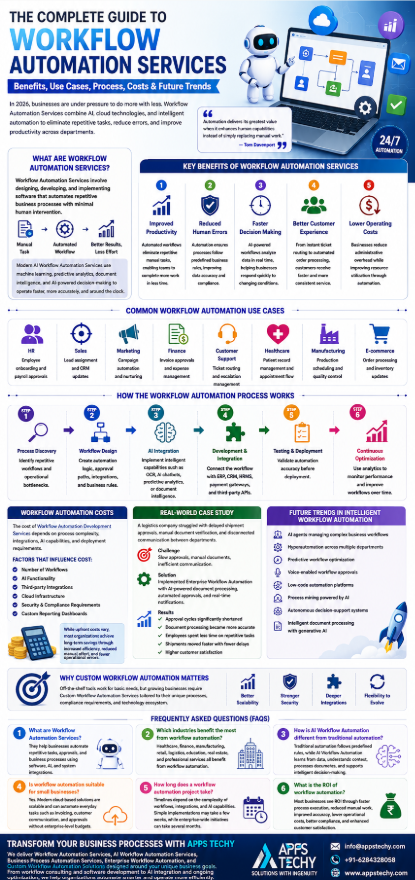
Common Workflow Automation Use Cases
Almost every department can benefit from Workflow Automation Solutions, including:
- HR employee onboarding and payroll approvals
- Sales lead assignment and CRM updates
- Marketing campaign automation
- Finance invoice approvals and expense management
- Customer support ticket routing
- Healthcare patient record management
- Manufacturing production scheduling
- E-commerce order processing and inventory updates
How the Workflow Automation Process Works
A successful Custom Workflow Automation project typically follows these steps:
Step 1: Process Discovery
Identify repetitive workflows and operational bottlenecks.
Step 2: Workflow Design
Create automation logic, approval paths, integrations, and business rules.
Step 3: AI Integration
Implement intelligent capabilities such as OCR, AI chatbots, predictive analytics, or document intelligence.
Step 4: Development & Integration
Connect the workflow with ERP, CRM, HRMS, payment gateways, and third-party APIs.
Step 5: Testing & Deployment
Validate automation accuracy before deployment.
Step 6: Continuous Optimization
Use analytics to monitor performance and improve workflows over time.
Workflow Automation Costs
The cost of Workflow Automation Development Services depends on process complexity, integrations, AI capabilities, and deployment requirements.
Typical factors influencing investment include:
- Number of workflows
- AI functionality
- Third-party integrations
- Cloud infrastructure
- Security and compliance requirements
- Custom reporting dashboards
While upfront development costs vary, most organizations achieve long-term savings through increased efficiency, reduced manual effort, and fewer operational errors.
Real-World Case Study
A logistics company struggled with delayed shipment approvals, manual document verification, and disconnected communication between departments. By implementing Enterprise Workflow Automation with AI-powered document processing, automated approvals, and real-time notifications, the company transformed its operations.
Approval cycles were significantly shortened, document processing became more accurate, and employees spent less time on repetitive administrative tasks. Customer satisfaction also improved because shipments moved through the system faster and with fewer delays. The project demonstrated that automation delivers the greatest value when it connects people, processes, and data into one seamless workflow.
Future Trends in Intelligent Workflow Automation
The next generation of AI Business Automation is evolving rapidly. Businesses should prepare for:
- AI agents managing complex business workflows
- Hyperautomation across multiple departments
- Predictive workflow optimization
- Voice-enabled workflow approvals
- Low-code automation platforms
- Process mining powered by AI
- Autonomous decision-support systems
- Intelligent document processing with generative AI
Organizations adopting these innovations early will gain a competitive advantage through faster operations and greater scalability.
Why Custom Workflow Automation Matters
While off-the-shelf workflow tools work for basic needs, growing businesses often require Custom Workflow Automation Services tailored to their unique processes, compliance requirements, and technology ecosystem.
A customized solution provides better scalability, stronger security, deeper integrations, and the flexibility to evolve as business needs change.
Frequently Asked Questions (FAQs)
Workflow Automation Services help businesses automate repetitive tasks, approvals, and business processes using software, AI, and system integrations.
Healthcare, finance, manufacturing, retail, logistics, education, real estate, and professional services all benefit from workflow automation.
Traditional automation follows predefined rules, while AI Workflow Automation learns from data, understands context, processes documents, and supports intelligent decision-making.
Yes. Modern cloud-based Workflow Management Solutions are scalable and can automate everyday tasks such as invoicing, customer communication, and approvals without requiring enterprise-level budgets.
Project timelines depend on the complexity of workflows, integrations, and AI capabilities. Simple implementations may take a few weeks, while enterprise-wide automation initiatives can take several months.
Most businesses see ROI through faster process execution, reduced manual work, improved accuracy, lower operational costs, better compliance, and enhanced customer satisfaction.
Transform Your Business Processes with AppsTechy
Modern businesses need more than basic automation—they need intelligent systems that streamline operations, integrate seamlessly with existing platforms, and scale with future growth. At AppsTechy, we deliver Workflow Automation Services, AI Workflow Automation Services, Business Process Automation Services, Enterprise Workflow Automation, and Custom Workflow Automation Solutions designed around your unique business goals. From workflow consulting and software development to AI integration and ongoing optimization, our experts help organizations automate smarter and operate more efficiently. Contact AppsTechy today to discover how our workflow automation expertise can reduce costs, improve productivity, and accelerate your digital transformation.