

Artificial intelligence is no longer an experimental technology reserved for enterprise giants. In 2026, businesses of every size are integrating AI into their applications to automate operations, improve customer experiences, and make faster, data-backed decisions. However, simply adding an AI chatbot isn’t enough. The real competitive advantage comes from building applications that combine multiple AI capabilities into one intelligent ecosystem.
According to industry research, organizations using AI-powered business applications report significantly faster decision-making, improved operational efficiency, and better customer satisfaction than businesses relying solely on traditional software. The question isn’t whether your business needs AI—it’s whether your application includes the right AI features.
This guide explores the 20 must-have AI features that modern business applications should include to remain competitive in 2026 and beyond.
Why AI Features Matter More Than Ever
Modern users expect software to understand context, predict needs, automate repetitive tasks, and provide personalized experiences. Businesses that fail to deliver these intelligent experiences often struggle with lower engagement and slower growth.
Instead of replacing employees, today’s AI applications are designed to enhance productivity, reduce manual work, and help teams make smarter decisions.
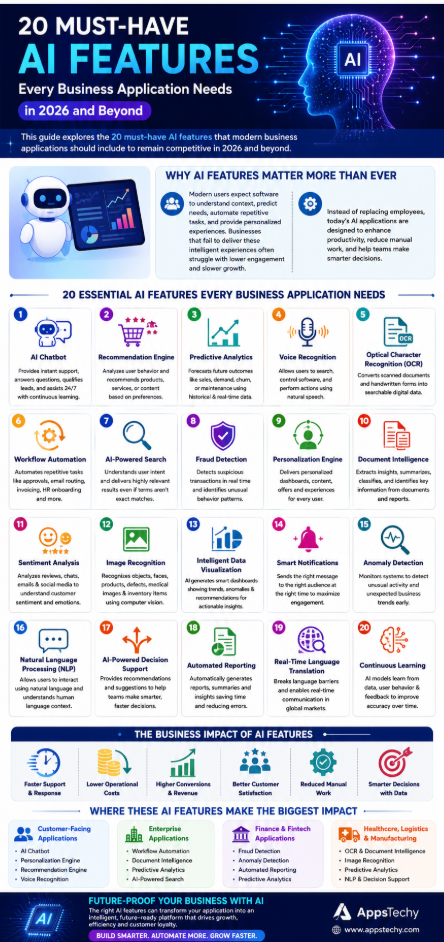
20 Essential AI Features Every Business Application Needs
1. AI Chatbot
An intelligent chatbot provides instant customer support, answers common questions, qualifies leads, and assists users 24/7. Unlike rule-based bots, AI chatbots understand intent and improve through continuous learning.
Business Benefit: Faster support and reduced operational costs.
2. Recommendation Engine
Recommendation systems analyze user behavior and suggest products, services, or content based on preferences.
Popular examples include Netflix recommendations and Amazon product suggestions.
Business Benefit: Higher conversions and increased customer engagement.
3. Predictive Analytics
Predictive analytics uses historical and real-time data to forecast future outcomes such as sales trends, inventory demand, customer churn, or equipment maintenance.
Business Benefit: Better strategic planning with data-driven decisions.
4. Voice Recognition
Voice-enabled applications improve accessibility while allowing users to search, control software, or perform actions using natural speech.
This feature has become increasingly valuable for mobile applications and enterprise productivity tools.
5. Optical Character Recognition (OCR)
OCR converts scanned documents, invoices, contracts, receipts, and handwritten forms into searchable digital data.
Business Benefit: Faster document processing and reduced manual data entry.
6. Workflow Automation
AI automatically handles repetitive processes like approvals, email routing, ticket management, invoice processing, and HR onboarding.
Businesses save countless hours while minimizing human error.
7. AI-Powered Search
Traditional keyword search is becoming outdated.
Semantic AI search understands user intent and delivers highly relevant results even when search terms aren’t exact matches.
8. Fraud Detection
Banks, insurance companies, fintech firms, and eCommerce platforms increasingly rely on AI to detect suspicious transactions in real time.
Machine learning identifies unusual behavioral patterns before fraud occurs.
9. Personalization Engine
Every customer expects personalized experiences.
AI dynamically adjusts dashboards, recommendations, marketing messages, pricing, and user journeys based on individual behavior.
10. Document Intelligence
Beyond OCR, document intelligence extracts insights from contracts, legal files, financial statements, PDFs, and reports.
The application can summarize documents, classify them, and identify key information automatically.
11. Sentiment Analysis
AI evaluates customer reviews, emails, chat conversations, and social media interactions to determine emotional sentiment.
Businesses can quickly identify unhappy customers before issues escalate.
12. Image Recognition
Computer vision enables applications to recognize products, defects, faces, documents, medical images, and inventory items.
Industries such as healthcare, manufacturing, logistics, and retail increasingly depend on this capability.
13. Intelligent Data Visualization
Instead of static reports, AI automatically generates dashboards highlighting trends, anomalies, and recommendations.
Executives receive actionable insights instead of overwhelming spreadsheets.
14. Smart Notifications
AI determines the right message, the right audience, and the best time for notifications.
This significantly improves engagement while reducing notification fatigue.
15. Anomaly Detection
AI continuously monitors systems to identify unusual activity such as network attacks, server failures, operational issues, or unexpected business trends.
Early detection minimizes downtime and financial losses.
16. Natural Language Processing (NLP)
NLP allows users to interact naturally through text instead of complicated commands.
Applications can summarize documents, answer questions, translate languages, and understand user intent with remarkable accuracy.
17. AI-Based Decision Support
Rather than replacing managers, AI provides recommendations backed by data.
For example, an ERP system may recommend optimal inventory levels based on historical demand and seasonal patterns.
18. Automated Report Generation
AI can generate weekly sales reports, financial summaries, HR analytics, or executive dashboards without manual effort.
This improves reporting consistency while saving valuable employee time.
19. Real-Time Translation
Global businesses increasingly need multilingual applications.
AI translation enables seamless communication across different languages without hiring dedicated translators for every interaction.
20. Continuous Learning Models
Modern AI applications don’t remain static.
Machine learning continuously improves predictions, recommendations, and automation as new business data becomes available.
This ensures software becomes smarter over time.
Real-World Example: How AI Features Transform Business Operations
A mid-sized logistics company struggled with delayed deliveries, manual paperwork, and increasing customer complaints. Instead of investing in multiple disconnected tools, the company implemented an AI-powered logistics platform combining predictive analytics, OCR, workflow automation, anomaly detection, and AI search.
Within months, invoice processing time dropped dramatically, delivery planning became more accurate, and support teams resolved customer queries faster using AI-powered document search. The business also reduced operational bottlenecks by automating repetitive workflows, allowing employees to focus on higher-value tasks. The result was improved customer satisfaction and a measurable increase in operational efficiency—demonstrating that the greatest impact comes from integrating complementary AI capabilities rather than deploying isolated features.
Expert Insight
As AI strategist Andrew Ng has frequently emphasized, AI creates the most value when it automates repetitive processes and augments human decision-making rather than simply replacing human effort. That principle is reflected in today’s leading business applications, where AI works alongside employees to improve productivity, accuracy, and customer experience.
Data-Driven Perspective
Recent industry studies show that organizations adopting AI-powered business applications are seeing measurable improvements across core business metrics. Companies report faster decision-making, reduced operational costs, improved customer satisfaction, and greater employee productivity by combining automation with intelligent insights. Businesses that implement multiple AI capabilities—such as predictive analytics, personalization, and workflow automation—typically achieve stronger outcomes than those relying on a single AI feature, making an integrated AI strategy increasingly important for long-term digital transformation.
How to Prioritize AI Features for Your Business
Not every application needs all 20 features on day one. The best approach is to align AI capabilities with your business goals.
- Customer-facing platforms: AI Chatbot, Personalization, Recommendation Engine, Voice Recognition.
- Enterprise software: Workflow Automation, Document Intelligence, Predictive Analytics, AI Search.
- Financial applications: Fraud Detection, Anomaly Detection, Automated Reporting.
- Healthcare and logistics: OCR, Image Recognition, NLP, Decision Support Systems.
Building in phases helps control costs while ensuring each feature delivers measurable business value.
Frequently Asked Questions (FAQs)
1. What are AI-powered business applications?
AI-powered business applications use technologies such as machine learning, natural language processing, computer vision, and predictive analytics to automate tasks, analyze data, and improve decision-making.
2. Which AI feature should businesses implement first?
It depends on your goals. Customer-centric businesses often benefit from AI chatbots and personalization, while operational teams may see faster ROI from workflow automation and predictive analytics.
3. Is AI only suitable for large enterprises?
No. Cloud-based AI services and modern development frameworks have made advanced AI capabilities accessible and affordable for startups, SMEs, and growing businesses.
4. How does AI improve customer experience?
AI enables faster responses, personalized recommendations, intelligent search, proactive support, and seamless interactions across multiple channels, leading to higher customer satisfaction.
5. Can AI-powered applications integrate with existing business software?
Yes. Modern AI applications can integrate with CRM systems, ERP platforms, accounting software, HR tools, payment gateways, and third-party APIs to extend the value of your existing technology stack.
6. How do businesses ensure AI applications remain secure?
Organizations should implement strong data governance, encryption, role-based access controls, continuous monitoring, and regular AI model evaluations to maintain security, privacy, and regulatory compliance.
Future-Proof Your Business with AppsTechy
Building a successful AI-powered application is about more than adding a chatbot or automating a single task. It requires selecting the right mix of intelligent features that solve real business challenges, improve user experiences, and scale as your organization grows. At AppsTechy, we specialize in AI-powered application development, custom software development, SaaS solutions, workflow automation, API integrations, and intelligent business applications tailored to your unique goals. Whether you’re planning a new AI product or upgrading an existing platform with advanced capabilities, our experts can help you design, develop, and deploy scalable AI solutions that deliver measurable business outcomes. Contact AppsTechy today to discuss your project and discover how the right AI features can accelerate your digital transformation.