
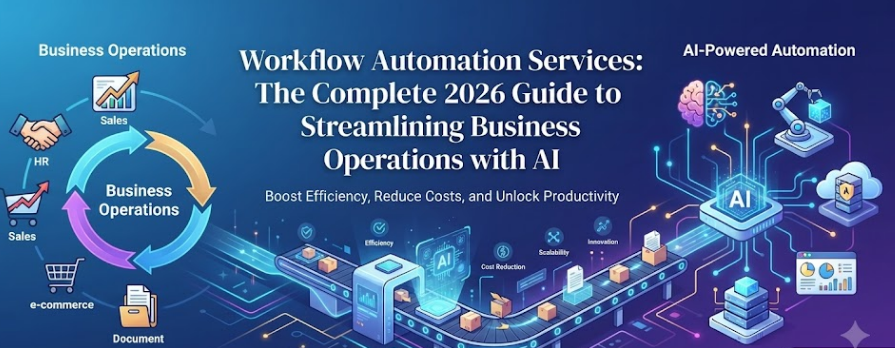
Modern businesses can no longer afford slow, repetitive, and manual processes. From managing customer inquiries to processing invoices and onboarding employees, repetitive tasks consume valuable time and increase the risk of human error. That’s why organizations across industries are investing in Workflow Automation Services powered by Artificial Intelligence (AI) to improve productivity, reduce operational costs, and accelerate business growth.
In this 2026 guide, we’ll explore how AI-driven workflow automation is transforming business operations, the measurable benefits it delivers, and how companies can implement automation successfully.
What Are Workflow Automation Services?
Workflow Automation Services involve designing and implementing technology that automates repetitive business processes with minimal human intervention. Instead of relying on manual approvals, spreadsheets, or emails, automated workflows connect your business applications, trigger actions, and ensure tasks move seamlessly from one stage to another.
With AI integration, workflow automation goes beyond predefined rules. It can intelligently classify documents, predict outcomes, analyze customer requests, automate decisions, and continuously optimize processes based on real-time data.
Why AI-Powered Workflow Automation Matters in 2026
As businesses embrace digital transformation, automation has become a competitive necessity rather than a convenience.
According to recent industry reports, organizations that implement workflow automation often experience:
- Up to 30% lower operational costs
- Faster task completion and approval cycles
- Fewer manual errors and improved compliance
- Higher employee productivity
- Better customer experiences through faster response times
The integration of AI enables businesses to automate not just repetitive work but also decision-making processes that previously required human involvement.
Business Processes That Deliver the Highest ROI
Workflow automation can streamline nearly every department within an organization.
Some of the most impactful use cases include:
- Employee onboarding and HR approvals
- Customer support ticket routing
- Sales lead qualification
- Invoice processing and finance approvals
- Inventory and procurement management
- CRM and ERP integrations
- Marketing campaign automation
- Document verification and compliance workflows
By eliminating bottlenecks, businesses allow employees to focus on strategic and customer-focused work.
Case Study: AI Workflow Automation in Action
A mid-sized healthcare provider struggled with manually processing patient registrations and appointment approvals, resulting in long wait times and administrative delays.
After implementing an AI-powered workflow automation solution, the organization achieved:
- 65% faster patient onboarding
- 40% reduction in administrative workload
- Improved appointment scheduling accuracy
- Enhanced patient satisfaction through quicker service delivery
This example demonstrates how intelligent automation can improve both operational efficiency and customer experience.
Expert Insight
“The most successful organizations don’t automate everything—they automate the right processes first and continuously optimize them with data.” — Digital Transformation Strategy Expert
This highlights an important principle: automation should solve real business challenges rather than simply replacing manual tasks.
Best Practices for Successful Workflow Automation
To maximize results, businesses should follow a strategic approach:
- Identify repetitive, high-volume processes first.
- Map existing workflows before automation.
- Integrate AI for intelligent decision-making where appropriate.
- Connect automation with existing business systems like CRM, ERP, and HRMS.
- Monitor workflow performance using analytics and continuously refine processes.
A phased implementation often delivers better adoption and measurable ROI than attempting to automate everything at once.
The Future of Workflow Automation
By 2026, workflow automation is evolving beyond rule-based systems. AI-powered platforms can now understand natural language, process unstructured data, generate insights, and make context-aware decisions.
Businesses that invest early in intelligent automation will be better equipped to scale operations, reduce costs, and adapt quickly to changing customer expectations.
Frequently Asked Question
What are Workflow Automation Services?
Workflow Automation Services help businesses automate repetitive tasks, approvals, and business processes using software and AI technologies to improve efficiency and reduce manual work.
Which businesses benefit from workflow automation?
Businesses of all sizes across healthcare, finance, manufacturing, retail, logistics, education, and professional services can benefit from workflow automation.
How is AI different from traditional workflow automation?
Traditional automation follows predefined rules, while AI-powered automation can analyze data, recognize patterns, make recommendations, and adapt workflows intelligently.
Can workflow automation integrate with existing software?
Yes. Modern workflow automation platforms integrate with CRM systems, ERP software, HRMS, cloud applications, accounting tools, and other business systems through APIs.
How long does workflow automation implementation take?
Implementation timelines depend on project complexity. Simple workflows may be deployed in a few weeks, while enterprise-wide automation projects may take several months.
Is workflow automation suitable for small businesses?
Absolutely. Small and medium-sized businesses can automate routine operations, improve productivity, and scale more efficiently without significantly increasing operational costs.
Transform Your Business with AppsTechy’s Workflow Automation Services
At AppsTechy, we help businesses streamline operations through custom Workflow Automation Services powered by AI and intelligent process optimization. Whether you want to automate approvals, integrate business applications, optimize customer workflows, or build scalable enterprise solutions, our team delivers tailored automation strategies designed around your business goals.
Ready to eliminate repetitive tasks and improve operational efficiency? Contact AppsTechy today to explore our Workflow Automation Services and discover how AI-driven automation can help your business work smarter, scale faster, and stay competitive in 2026 and beyond.