
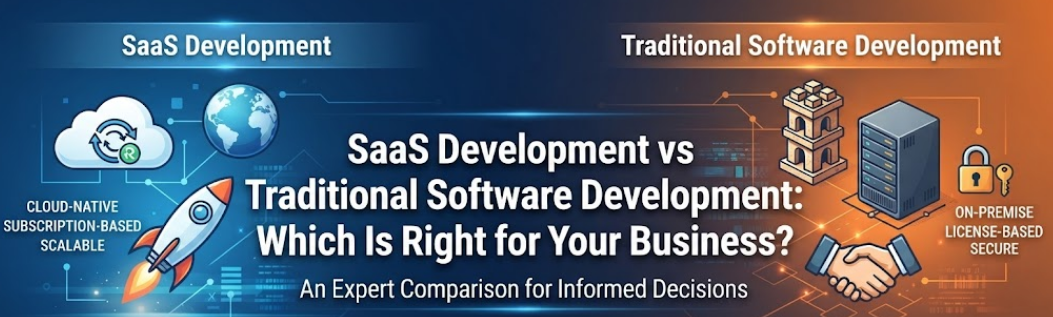
In today’s digital-first economy, choosing the right software model can significantly impact your company’s scalability, costs, and long-term growth. As businesses increasingly adopt cloud-based technologies and AI-driven workflows, the debate between SaaS development and traditional software development has become more relevant than ever.
So, which approach is the better fit for your business in 2026? Let’s break it down.
Understanding the Difference
What Is SaaS Development?
Software as a Service (SaaS) refers to cloud-hosted applications that users access through a web browser or mobile app. Instead of installing software locally, customers subscribe to a service that is continuously updated and maintained by the provider.
Examples include Salesforce, Slack, HubSpot, Zoom, and Notion.
What Is Traditional Software Development?
Traditional software is typically installed on local servers, desktops, or enterprise infrastructure. Organizations purchase a license and manage updates, maintenance, security, and infrastructure internally.
Examples include legacy ERP systems, desktop accounting software, and custom on-premise enterprise applications.
The Business Shift Toward SaaS in 2026
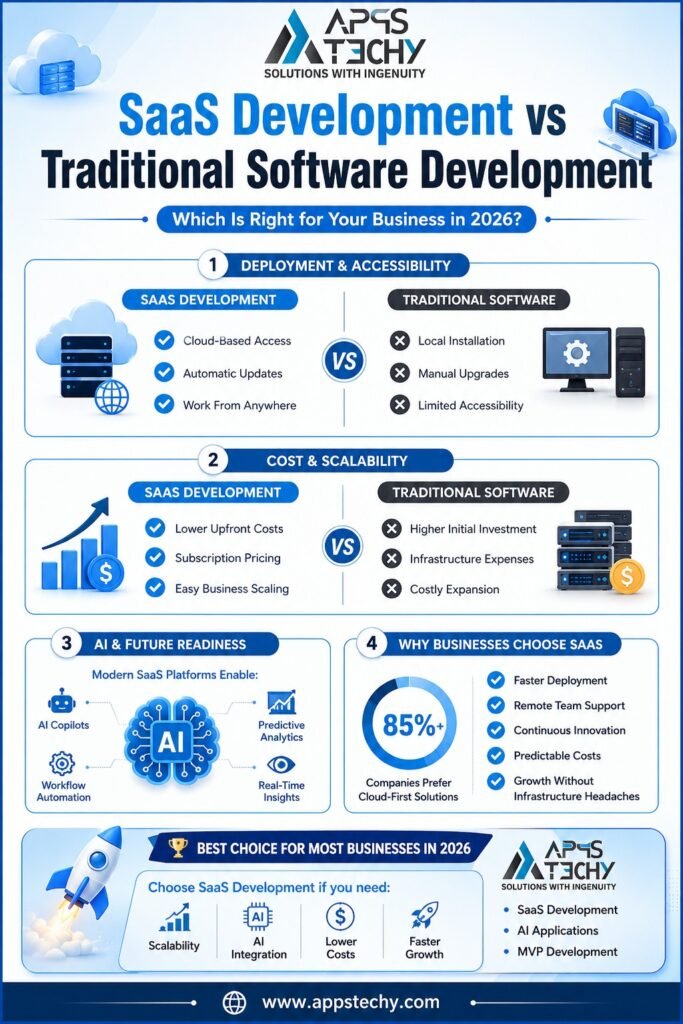
According to Gartner, more than 85% of businesses now prioritize cloud-first technology investments, while AI-powered SaaS platforms continue to dominate software spending across industries.
The reason is simple: businesses need flexibility.
Modern organizations want solutions that can:
- Scale instantly
- Support remote teams
- Integrate with AI tools
- Reduce infrastructure costs
- Deliver continuous innovation
Traditional software often struggles to keep pace with these requirements.
Comparing SaaS and Traditional Software Development
Deployment & Accessibility
SaaS Development
- Cloud-based deployment
- Accessible from anywhere
- Automatic updates
- Faster implementation
Traditional Software
- Local installation required
- Limited remote accessibility
- Manual upgrades
- Longer deployment cycles
For companies with distributed teams or global customers, SaaS offers a significant operational advantage.
Cost Structure
One of the biggest differences is how businesses pay for software.
SaaS
- Subscription-based pricing
- Lower upfront investment
- Predictable monthly expenses
Traditional Software
- Higher initial licensing costs
- Hardware and infrastructure expenses
- Additional maintenance costs
For startups and growing businesses, SaaS development often provides a more budget-friendly path to market.
Scalability
A rapidly growing business needs software that grows alongside it.
SaaS platforms are designed with scalable cloud architecture, allowing companies to add users, storage, and features without major infrastructure changes.
Traditional systems frequently require expensive server upgrades and additional IT resources as demand increases.
Real-World Example: Startup Growth Through SaaS
Consider a healthcare startup that launched a patient management platform.
Initially, the founders evaluated a traditional on-premise solution. However, after calculating infrastructure, maintenance, and support costs, they opted for a SaaS-based platform.
Within two years:
- User base grew from 500 to 25,000+
- Infrastructure costs remained predictable
- New AI-powered features were deployed monthly
- Customer onboarding became fully automated
The SaaS model enabled faster growth without significant operational overhead.
Expert Perspective–
As Satya Nadella, CEO of Microsoft, has often emphasized:
“Every company is becoming a software company.”
In 2026, many experts would extend that statement further:
“Every software company is becoming a cloud and AI company.”
Businesses investing in software today must think beyond functionality and consider long-term adaptability, AI integration, and scalability.
When Traditional Software Still Makes Sense
Despite the popularity of SaaS, traditional software remains valuable in certain scenarios:
- Highly regulated industries with strict data residency requirements
- Organizations requiring complete infrastructure control
- Legacy enterprise environments with limited cloud adoption
- Specialized systems that operate offline
In these cases, traditional development may still offer advantages.
The AI Factor: Why SaaS Has the Edge
One of the strongest arguments for SaaS development in 2026 is AI integration.
Modern SaaS platforms can quickly adopt:
- AI copilots
- Predictive analytics
- Workflow automation
- Intelligent customer support
- Machine learning models
- Real-time business insights
Cloud-native architecture makes it easier to deploy and continuously improve AI capabilities without disrupting users.
Final Thoughts
The decision between SaaS development and traditional software development ultimately depends on your business goals. If your priorities include scalability, AI readiness, lower infrastructure costs, remote accessibility, and continuous innovation, SaaS development is often the smarter investment.
However, if your organization requires complete control over infrastructure, strict compliance management, or offline functionality, traditional software may still be appropriate.
For most modern businesses, the future is increasingly cloud-driven, AI-enabled, and subscription-based—making SaaS development the preferred choice for long-term growth.
Frequently Asked Questions (FAQs)
What is the main difference between SaaS and traditional software?
SaaS applications are hosted in the cloud and accessed through the internet, while traditional software is typically installed and managed on local systems or servers.
Is SaaS development cheaper than traditional software development?
SaaS generally requires lower upfront investment and offers predictable subscription costs, making it more cost-effective for many businesses.
Why are companies moving to SaaS platforms?
Businesses benefit from greater scalability, easier maintenance, remote accessibility, automatic updates, and faster deployment.
Can SaaS applications integrate with AI technologies?
Yes. Modern SaaS platforms are ideal for integrating AI features such as chatbots, predictive analytics, automation tools, and intelligent recommendations.
Is traditional software becoming obsolete?
Not entirely. Traditional software still serves industries that require strict security controls, offline functionality, or specialized infrastructure requirements.
How do I decide which model is right for my business?
Consider factors such as budget, scalability needs, compliance requirements, remote workforce support, AI adoption goals, and long-term growth strategy. Consulting with an experienced SaaS development company like AppsTechy can help you make the right decision.
Looking to build a scalable SaaS product or modernize your existing software?
AppsTechy specializes in SaaS Development, AI-Powered Applications, MVP Development, and Custom Software Solutions designed to help businesses innovate faster and grow smarter.